
Documents and FAQs
We’ll try to answer your initial questions.
OUR CERTIFICATIONS
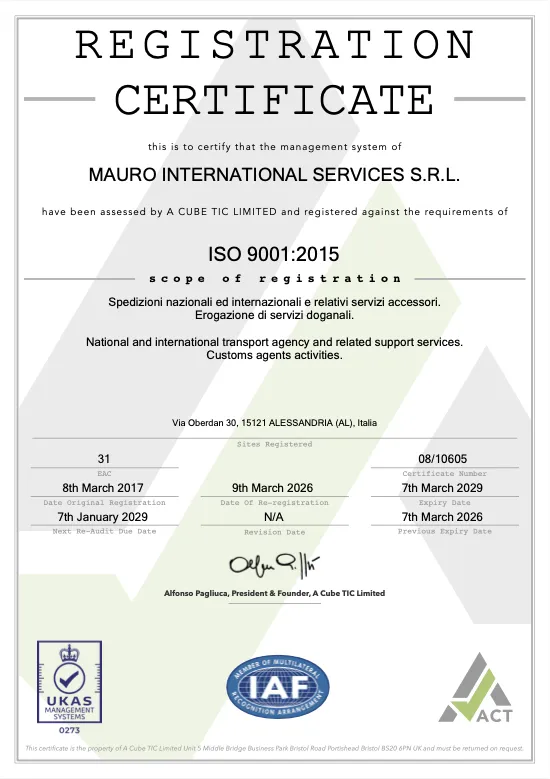
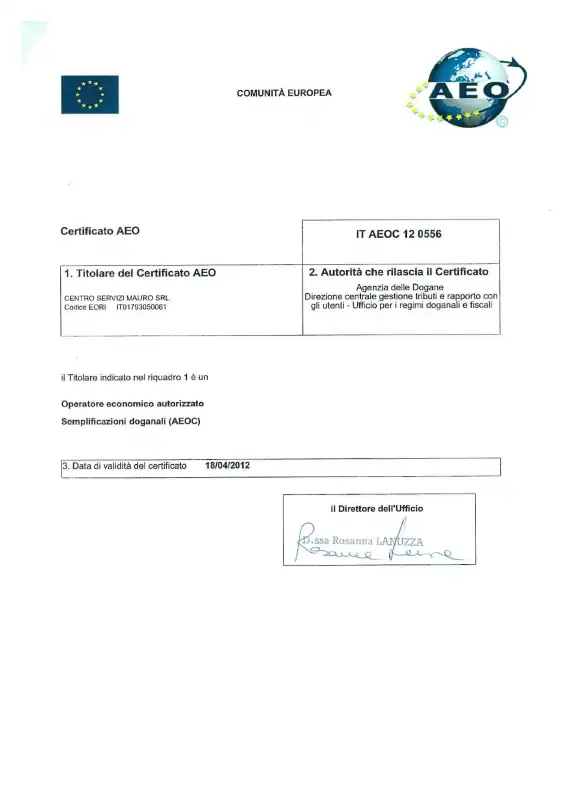
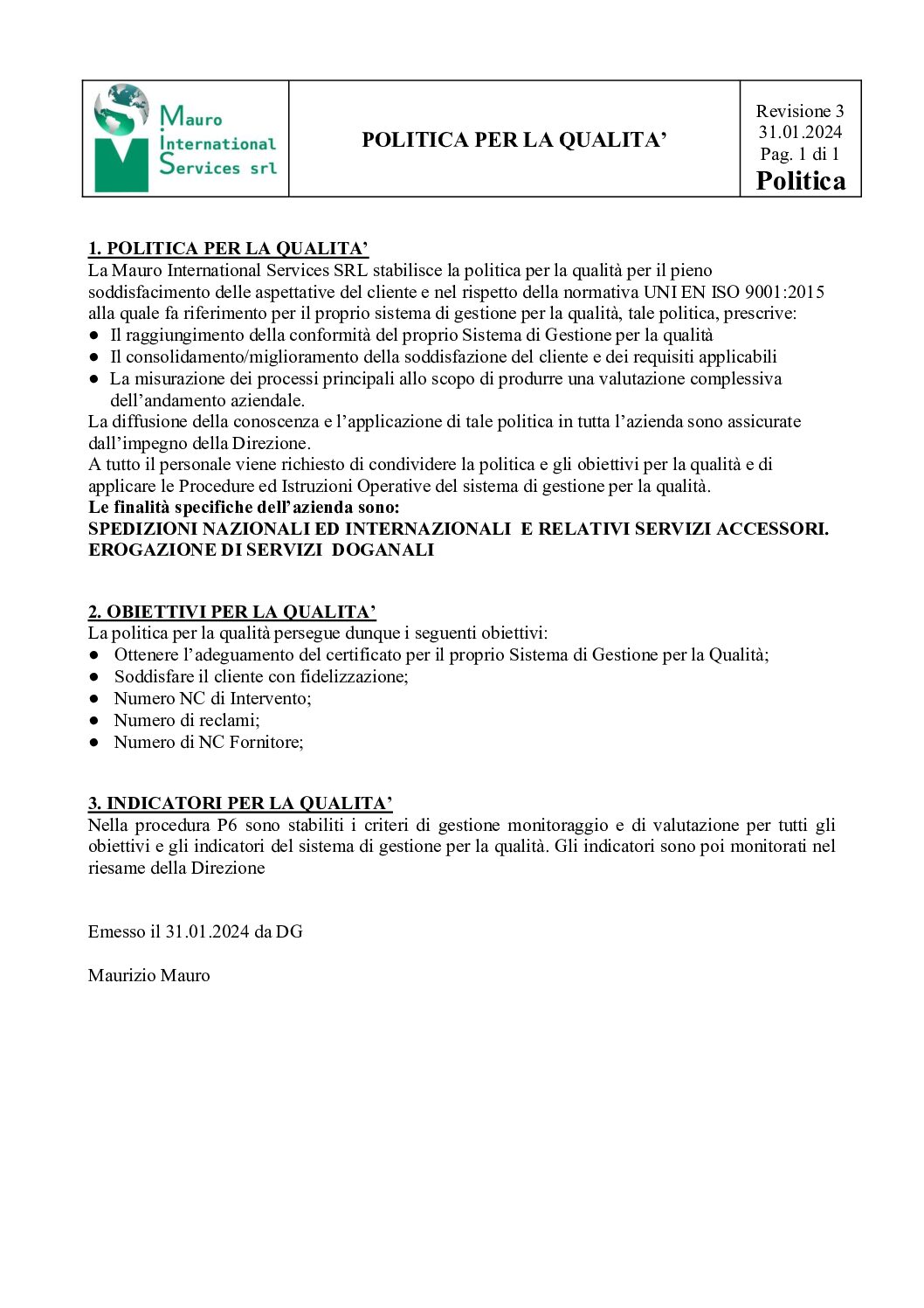
In 2008, MAURO acquired ISO quality certification, which it maintained in subsequent years. In 2012, it obtained AEO Custom certification from the Italian Customs Agency, as a reliable and competent entity for customs purposes, with the highest score (double A).
“The road is long when you don’t know where you’re going.”
Bertolt Brecht
Frequently Asked Questions
These are questions we often get asked. If you don’t find the answer you’re looking for, please contact us via the contact page
What is an FCL?
In FCL (Full Container Load) shipments, the goods occupy the entire container without sharing space with other shippers.
This type of shipping offers several advantages:
– the shipper can load the goods directly into the container and can be sure that they will only be moved during unloading.
– faster transit times.
At the same time, it is not advantageous if the shipper does not have enough goods to fill the container.
Request a free quote
What is an LCL?
LCL (Less than Container Load) shipments are used for small shipments when it is not possible to utilize the full capacity of a full container.
The advantages of LCL are:
– the ability to ship small consignments while optimizing costs
– always reserved space on the vessel
What is the difference between a customs warehouse and a VAT warehouse?
A customs warehouse is a special suspensive regime, authorized by the Customs Agency and reserved for goods arriving from third countries that have not yet cleared customs.
Placing goods in a customs warehouse allows for the suspension of both duties and VAT until the moment of withdrawal.
A VAT warehouse, on the other hand, is a tax regime governed by Article 50bis of Legislative Decree 331/93. Only domestic or EU goods (i.e., non-EU goods already released for free circulation in the European Union with payment of duties) are permitted in a VAT warehouse. This regime allows for the suspension of VAT only.
Payment of the duty is deferred until the moment of withdrawal using the reverse charge method, without any actual disbursement.
Request a free quote
What is ISPM15/FITOK fumigation?
Fumigation according to the ISPM15 standard is a phytosanitary treatment for packaging made from raw wood.
In Europe, HT heat treatment is used; methyl bromide treatment has been banned since 2010 due to its negative environmental effects.
Once treated, the packaging is marked with a stamp showing:
– ISO country code (e.g., IT for Italy)
– Manufacturer’s identification code
– The abbreviation for the type of treatment used (HT or MB)
Which countries require ISPM15/FITOK treatment?
The updated list of countries requiring ISPM15/FITOK treatment is available at the following links: ENG / ITA
Request a free quote
What types of Bill of Lading are there?
The Bill of Lading (BOL) is the main maritime transport document. It can also serve as a negotiable instrument, representing the goods for collection at destination. Today, alongside the traditional BOL, there are other types of BOL used in special circumstances or for specific shipments. To provide a complete picture, consider:
- BL/OBL (Original Bill of Lading): in its non-negotiable form (when issued only to the designated recipient) or negotiable form (when the title can be transferred by endorsement). This is the traditional bill of lading.
- Telex release: This is a modified Original Bill of Lading (OBL) “with release at destination,” without the need to present the originals. The shipping company sends a message to the agent at destination indicating that the shipper does not have the OBLs available and that the shipment can be released anyway. This form is used when time is tight and there is an urgent need.
- Sea waybill: This allows the recipient to collect the goods directly. They are issued independently by the shipper when there is a consolidated relationship of trust with the receiving customer.
- Express release: From the outset, no additional documents are printed (unlike telex, which requires a transformation of the original BL). It has the same legal value as SWB. It is a form used for shipments to certain countries (e.g., China).
Can you manage triangular shipments abroad when the goods don’t enter Italy?
Using our select network of agents, present in over 130 countries worldwide, we can manage international shipments between two foreign countries (cross-trade) without the goods transiting through Italy. In this case, we follow the entire shipment from the country of origin to the destination, coordinating transportation, documentation, and logistics in accordance with international regulations.
Do you also handle shipments subject to documentary credits or other forms of international payment?
We regularly handle shipments subject to Letters of Credit (L/C) and documentary collections (CAD/D/P), taking into account the critical issues related to non-compliance and non-compliance imposed by these.
Our assistance includes a preliminary review of the L/C terms, logistical feasibility, and the issuance of bills of lading and other relevant documentation, all in compliance with banking instructions.
What experience do you have shipping industrial machinery from Italy?
Over the years, we have gained extensive experience shipping Made in Italy industrial machinery. We offer comprehensive support for this type of transport:
- Packaging analysis: advice on suitable crates and packaging for sea/air transport
- Management of bureaucratic procedures: special permits, technical escorts, issuing of securing certificates
- Project Cargo: for shipments of complete systems requiring multiple coordinated loads
- Management of exceptional OOG (out of gauge) loads: via flat rack, open top, and break bulk
CONTAINER TYPES
It’s a good idea to determine the correct container type in advance, knowing the overall dimensions and estimated final weight for your goods.
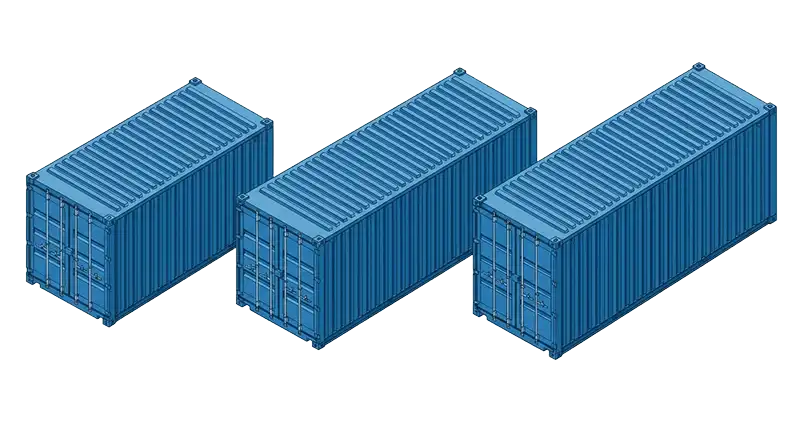
Standard (Dry / General Purpose)
These are the most commonly used containers for the transport of goods that do not require special requirements.
- 20-foot (1 TEU)
Internal dimensions: 5,89 x 2.34 x H 2.37 m
Maximum load (standard): 21720 kg
Maximum load (upgraded): 28250 kg - 40-foot (2 TEU)
Internal dimensions: 12,04 x 2.35 x H 2.39 m
Maximum load: 26780 kg - 40-foot HC (2 TEU)
Internal dimensions: 12,03 x 2.35 x H 2.70 m
Maximum load: 26540 kg
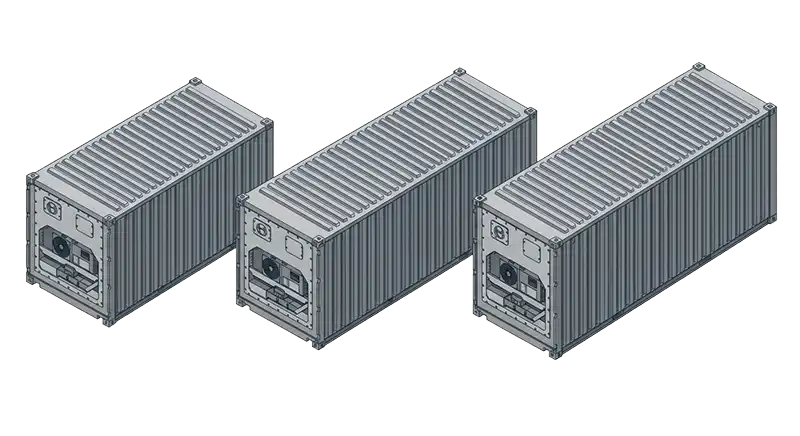
Reefer (Refrigerated)
These containers are used to load perishable goods that require temperature
control.
- 20-foot (1 TEU)
Internal dimensions: 5,45 x 2.29 x H 2.26 m
Maximum load: 20940 kg - 40-foot (2 TEU)
Internal dimensions: 11.58 x 2.28 x H 2.24 m
Maximum load: 25580 kg - 40-foot HC (2 TEU)
Internal dimensions: 11.55 x 2.28 x H 2.48 m
Maximum load: 26109 kg
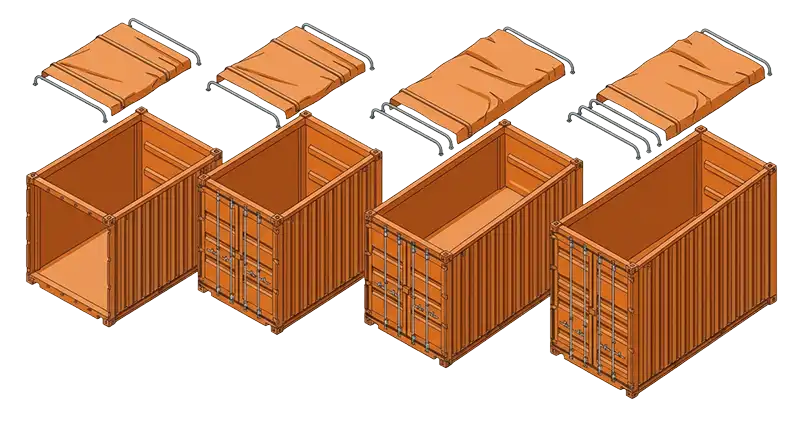
Open Top
These containers have a closed top with a tarpaulin supported by ribs. They are used when cargo cannot be loaded through the doors, precisely because these containers allow loading from above.
- 20-foot (1 TEU)
Internal dimensions: 5,89 x 2.35 x H 2.35 m
Maximum load:21770 kg - 20-foot HC (1 TEU)
Internal dimensions: 5,89 x 2.35 x H 2.65 m
Maximum load: 21770 kg - 40-foot (2 TEU)
Internal dimensions: 12.03 x 2.35 x H 2.36 m
Maximum load: 26630 kg - 40-foot HC (2 TEU)
Internal dimensions: 12.03 x 2.35 x H 2.65 m
Maximum load: 26540 kg
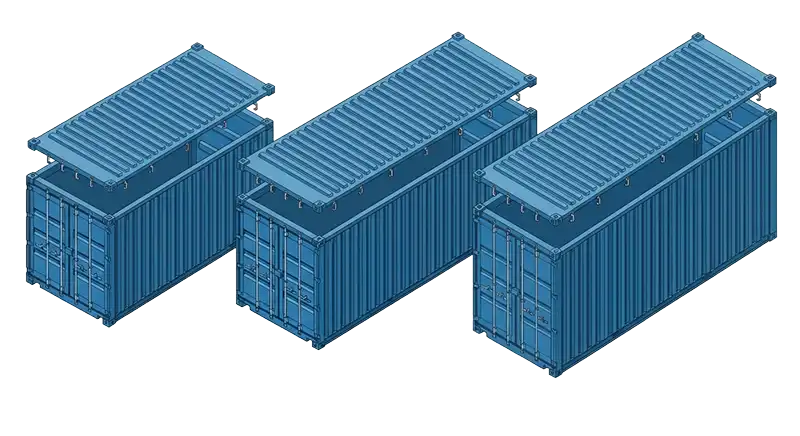
Hard Top
They have the same characteristics as Open Top containers, but the roof is made of the same material as the container (it is rigid). Unlike the Open Top, the Hard Top is chosen for more delicate shipments because it offers better protection from humidity.
- 20-foot (1 TEU)
Internal dimensions: 5,89 x 2.35 x H 2.35 m
Maximum load: 27780 kg - 40-foot (2 TEU)
Internal dimensions: 12.03 x 2.35 x H 2.36 m
Maximum load: 25780 kg - 40-foot HC (2 TEU)
Internal dimensions: 12.03 x 2.35 x H 2.65 m
Maximum load: 25580 kg
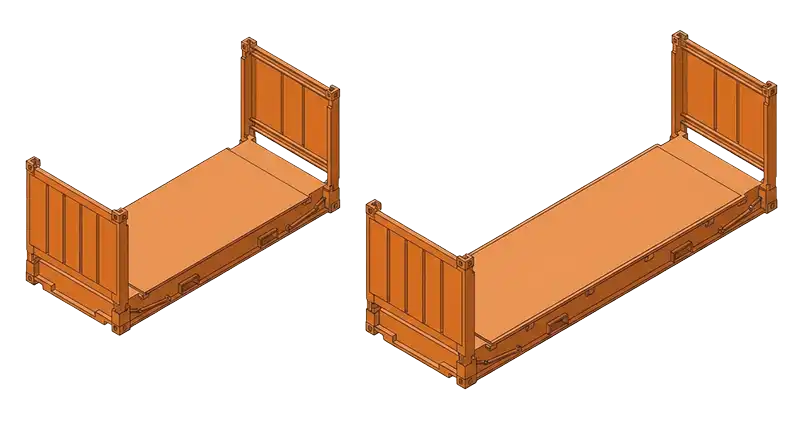
Flat Rack
These containers are designed to transport heavy, bulky, or oversized loads. They are used for shipments that cannot fit inside standard containers. They feature a reinforced floor and fixed or folding front walls.
- 20-foot (1 TEU)
Internal dimensions: 5,62 x 2.20 x H 2.23 m
Maximum load: 21469 kg - 40-foot (2 TEU)
Internal dimensions: 12.06 x 2.08 x H 1,95 m
Maximum load: 38918 kg
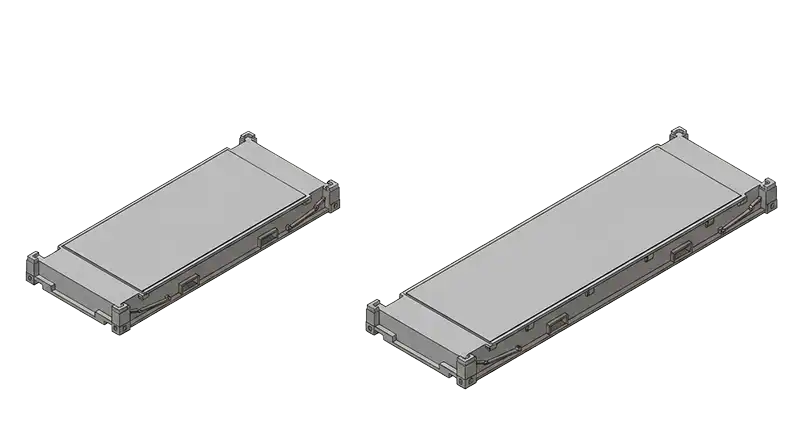
Platform
Like Flat Racks, these containers are designed to transport heavy, bulky, or oversized loads. The only difference is the lack of fronts, allowing the cargo to protrude out of the frame on all sides.
- 20-foot (1 TEU)
Internal dimensions: 6.07 x 2.43 x H 2.23 m
Maximum load: 23993 kg - 40-foot (2 TEU)
Internal dimensions: 12.06 x 2.43 x H 1,95 m
Maximum load: 30117 kg
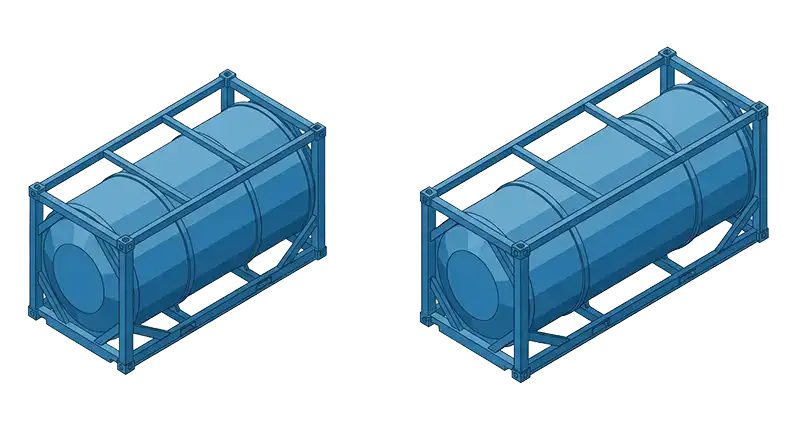
Tank Container
These are containers used for the transport of liquids or gases. These containers have an external cage that protects the tank.
- 20-foot (1 TEU)
Internal dimensions: 5,89 x 2.34 x H 2.37 m
Maximum load: 21720 kg - 40-foot (2 TEU)
Internal dimensions: 12,04 x 2.35 x H 2.39 m
Maximum load: 26780 kg
Useful Information
The measurements shown are indicative; they may vary by a few centimeters and vary from company to company.
As per IMO regulations, each container must be fitted with a CSC plate: this is a mandatory metal plate that lists the manufacturer’s details, the container number, and the maximum loadable weight.
Not all companies own this equipment. Some are rarer and sometimes unavailable in the requested port.
Tanks are usually owned by the shipping companies.
ONE CONTACT, INFINITE DESTINATIONS
Thanks to accreditation with the 3F, Freyt World, and Seajet Logistics networks, we have extended our operational standards to every continent. We don’t just ship goods: we activate a network of selected local agents who manage the customs complexities of their countries with the same care and experience as we do with Italy.
With Mauro, your goods travel safely everywhere: a single contact to manage your global supply chain.


MAURO International Services SRL
Via Oberdan, 30
15121 Alessandria
CF e P.IVA 01793050061
info (at) maurointernationalservices.com
© 2026 MAURO INTERNATIONAL SERVICES SRL • All Rights Reserved • VAT N. 01793050061